 Available in US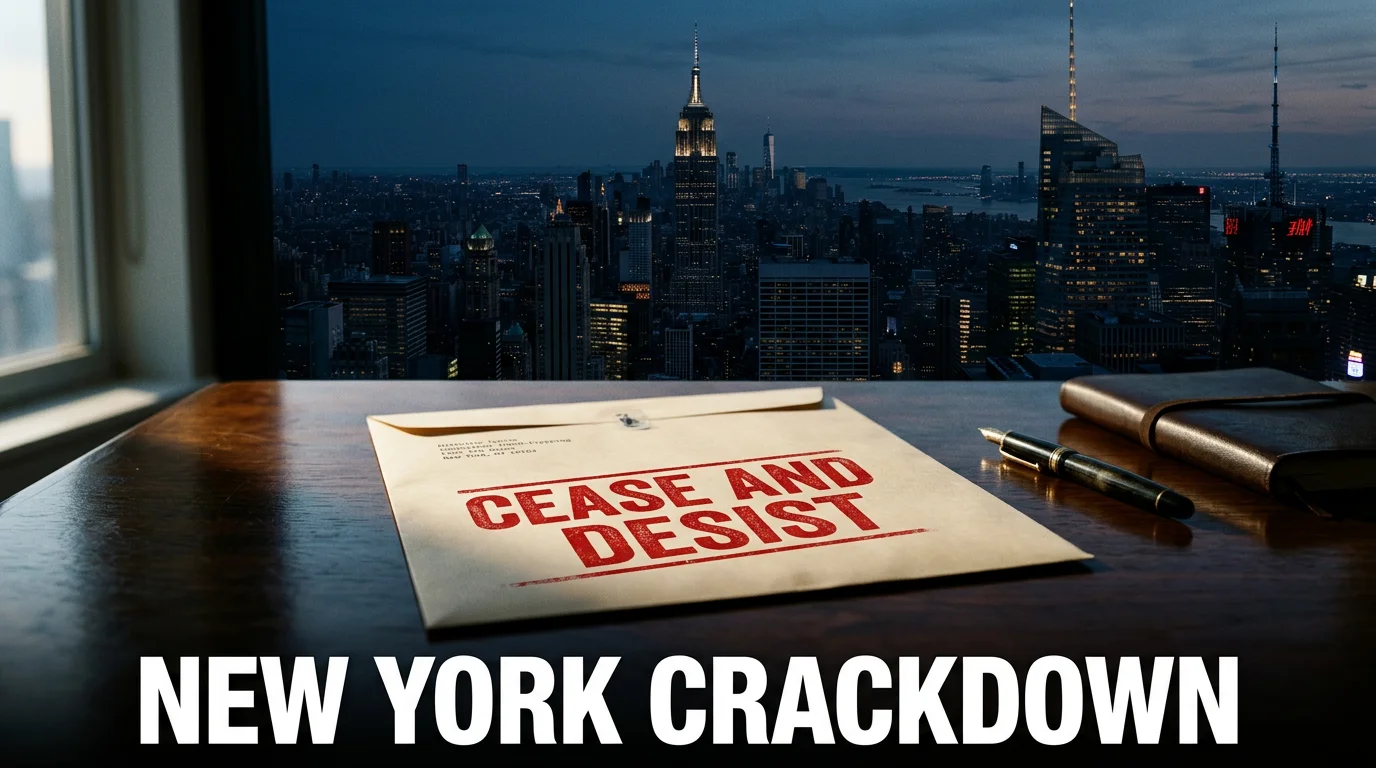
New York’s AG shut down sweepstakes casino sales with 26 cease-and-desist letters in June 2025. Unlike California’s legislative ban, New York achieved prohibition through aggressive enforcement of existing gambling laws. Attorney General Letitia James determined that sweepstakes casinos violated state statute regardless of how operators framed their business model, and she acted accordingly.
The enforcement action caught the industry off guard. New York had been a major market, generating hundreds of millions in annual revenue for sweepstakes operators. Within weeks of receiving cease-and-desist letters, every significant platform stopped selling Sweeps Coins to New York residents. The market didn’t disappear gradually — it ended abruptly when operators calculated that fighting the state’s top law enforcement official wasn’t worth the legal costs and reputational risks.
This article chronicles how New York’s sweepstakes casino access collapsed, what legal reasoning supported the crackdown, and what options remain for players in the state today.
New York Sweepstakes Casino Ban — More on this topic at sweepstakes casino promo code.
The June 2025 Crackdown
The enforcement wave began in early June 2025 when the Attorney General’s office sent cease-and-desist letters to 26 sweepstakes casino operators. The letters demanded immediate cessation of Sweeps Coin sales to New York residents and threatened legal action if platforms failed to comply. According to iGaming Business reporting, all 26 recipients stopped selling SC to New York players rather than challenge the state’s position.
The timing aligned with broader regulatory momentum against sweepstakes casinos. California’s legislative ban was advancing through the statehouse. Multiple state attorneys general had signaled concern about the industry. Class-action lawsuits were accumulating against major operators. New York’s action represented an enforcement-first approach that avoided the slower legislative process other states pursued.
The AG’s office argued that sweepstakes casinos constitute illegal gambling under New York law regardless of their promotional structure. The state’s gambling statutes define gambling broadly, and regulators concluded that the purchase-of-Gold-Coins-with-free-Sweeps-Coins model didn’t create meaningful legal distinction from direct wagering. If players purchase something specifically to receive something else that can be redeemed for cash, the transaction functionally resembles gambling.
Operators faced a difficult choice: fight the state’s interpretation in court — expensive, uncertain, and potentially extending to criminal liability — or withdraw from the market quietly. Every platform chose withdrawal. Some issued statements expressing disagreement with the AG’s legal reasoning while still complying. Others simply updated their terms of service to exclude New York without public comment. The practical result was identical: New York players lost access to sweepstakes casino purchases overnight.
The speed of compliance surprised some industry observers. Major platforms like Chumba Casino, Stake.us, McLuck, and others had substantial New York player bases generating significant revenue. Walking away from that revenue demonstrated how seriously operators took the enforcement threat. The calculation apparently concluded that fighting Letitia James wasn’t a battle worth having.
Letitia James’ Enforcement Actions
Attorney General Letitia James built a reputation for aggressive consumer protection enforcement before turning attention to sweepstakes casinos. Her office had previously pursued major corporations across industries, developing both the appetite and the infrastructure for complex enforcement actions. The sweepstakes casino campaign fit her broader pattern of targeting businesses she viewed as exploiting consumer confusion.
The New York State Gaming Commission supported the AG’s position. Chairman Brian O’Dwyer had publicly criticized sweepstakes casinos before the enforcement action, stating that these platforms were “unscrupulous, unsecure and unlawful.” This regulatory alignment meant operators faced unified state opposition rather than conflicting signals from different agencies.
The legal theory underlying enforcement relied on New York’s definition of gambling and its prohibition on unlicensed gambling operations. The AG’s office argued that the sweepstakes model’s legal defenses — no purchase necessary, Gold Coins as primary product, Sweeps Coins as promotional bonus — didn’t survive scrutiny under New York law. When 90% of players purchase GC specifically to receive SC that converts to cash, the promotional framing becomes transparent fiction according to this view.
Consumer complaints likely contributed to regulatory attention. Players who lost money, experienced redemption difficulties, or felt misled about the nature of sweepstakes platforms provided ammunition for enforcement agencies. The AG’s office frames its actions as consumer protection, and documented consumer harm supports that narrative.
The cease-and-desist letters represented civil enforcement rather than criminal prosecution. Operators weren’t arrested or charged with crimes — they were ordered to stop specific conduct. This approach achieved market clearance without the higher burden of proof required for criminal conviction. It also allowed operators to exit gracefully rather than facing the reputational damage of criminal proceedings.
2 Million Market Lost
New York represented approximately $762 million in annual sweepstakes casino revenue according to Eilers & Krejcik Gaming analysis. The state’s large population, high internet penetration, and limited legal gambling alternatives had made it one of the industry’s most valuable markets. Losing New York compounded the impact of California’s ban, which eliminated an even larger revenue pool.
The financial impact hit operators unevenly. Platforms with heavy New York concentration suffered proportionally more than those with diversified geographic footprints. Some smaller operators that had built substantial New York player bases found their business models fundamentally challenged by the sudden loss. Larger operators absorbed the hit more easily but still felt meaningful revenue decline.
Marketing economics shifted alongside revenue loss. Operators had invested significantly in New York player acquisition through advertising, promotional partnerships, and affiliate marketing. Those customer acquisition costs became stranded assets when acquired players could no longer generate revenue. Future marketing investments would necessarily focus on remaining accessible states, intensifying competition for players in those markets.
The combined California and New York losses exceeded $3 billion in annual revenue — roughly a third of the industry’s total US market at peak. This contraction forced operators to reassess growth assumptions, staffing levels, and expansion plans. The era of unconstrained sweepstakes casino growth ended in 2025, replaced by a reality of state-by-state battles for survival.
Current Status for NY Players
New York residents cannot currently purchase Sweeps Coins at any major sweepstakes casino. Platforms geoblock New York IP addresses and reject accounts with New York billing addresses. Attempting to circumvent these restrictions through VPNs or false address information violates platform terms of service and risks account termination with balance forfeiture.
Free play remains technically possible at some platforms. Gold Coins can be acquired through no-purchase methods like daily logins and mail-in requests, and these GC can be played for entertainment without cash redemption. However, most platforms have restricted even free SC acquisition for New York accounts, making meaningful play difficult.
Existing balances presented complications when the ban took effect. Players who had accumulated Sweeps Coins faced questions about redemption. Most platforms allowed New York players to redeem existing balances during a grace period, though specific policies varied. Players who missed redemption windows or fell below minimum thresholds had limited recourse.
The enforcement action didn’t criminalize individual players. New York residents who previously used sweepstakes casinos aren’t subject to prosecution for past activity. The enforcement targeted operators, not users. However, continuing to access platforms through technical workarounds could theoretically attract attention, though no individual enforcement actions against players have been reported.
Legal Alternatives in New York
New York offers several legal gambling options that partially substitute for sweepstakes casino access. The state has a mature gambling market including commercial casinos, tribal casinos, the lottery, horse racing, and legal sports betting. What New York lacks is legal online casino gaming — the specific gap sweepstakes casinos filled before enforcement.
Retail casinos operate throughout the state. Resorts World New York City, Empire City Casino, and other facilities offer slot machines and table games for players willing to travel to physical locations. The experience differs substantially from online play, but the games themselves are similar.
Mobile sports betting launched in New York in 2022 and operates legally through licensed operators like FanDuel, DraftKings, and others. Sports betting doesn’t replicate the casino slot experience, but it provides a legal mobile gambling option for players who enjoy wagering. The market has proven popular, generating billions in handle annually.
The New York Lottery offers various games including scratch tickets and draw games with prize potential. Online lottery ticket purchasing is available for some games. Again, this doesn’t replicate sweepstakes casino gameplay, but it provides legal gaming with real prize potential.
Online casino legalization efforts continue in the state legislature. Bills proposing iGaming regulation have been introduced in recent sessions, though none have passed. If New York eventually legalizes online casinos, players would gain access to regulated real-money platforms with consumer protections exceeding what sweepstakes casinos offered. Until then, New Yorkers seeking online casino-style play have no fully legal option available.
See also Why Sweepstakes Casinos Are Banned in Washington State.